Study more is not a diagnosis. SkoreMore is.
See what the marks don't show.
AI evaluates every answer against your marking scheme, your teacher approves — and every lost mark is traced to the topic behind it.
Question 5.
Solve: 7x − 4 = 3(x + 2)
7x − 4 = 3x + 6
4x = 2
x = 0.5
Sign error when transposing
4x should be 10, so x = 2.5
Marks awarded
2½/ 4
Next step
Practise transposing terms
Teacher approved — before anyone saw the mark
Who are you here for?
Everyone gets a different view. Pick yours.
Four questions. One diagnosis.
One paper. Four honest answers.
The school, the teacher, the student and the parent each ask something different. The same marked test paper answers all four.
“Which class needs help — before the board results say so?”
Every class opened concept by concept. You see it in October, not after the boards.
“Forty students. What do I re-teach tomorrow?”
A heatmap that names the chapter — and the six students who need it most.
“I studied this. Why didn’t it stick?”
Because facts weren’t the problem. We name the concept — and the thinking level behind the lost marks.
“Is my child actually improving?”
Before → after, per concept — in marks, not adjectives.
From marks to mastery
Three steps. Your teachers get their marking hours back.
Upload your students' answer papers
Scans or photos of the handwritten sheets, plus the question paper and marking scheme. Your teachers mark nothing — that's the point.
SkoreMore evaluates every answer
Three AI models grade each answer against your board's marking scheme — step-wise marks, units, partial credit. If they agree, the mark stands. If they don't, it's flagged, never guessed.
The teacher approves — and everyone gets a next step
The teacher signs off on the marks instead of writing them all by hand. The student sees what to practice, the parent gets a plain-English note, the teacher gets a heatmap of what to re-teach.
A diagnosis is only step two
We don't stop at telling you what went wrong.
Most tools end at a report. SkoreMore closes the loop — and every step lands where it matters.
Evaluate
Three AI models evaluate every answer. The teacher reviews and approves.
Diagnose
The topic behind every lost mark, named plainly.
Act
Students, parents and teachers each get their next step.
Practice
Fifteen minutes a day aimed exactly at the gaps — taught through what the student loves.
Prove
Concepts turn green. Goals get met. Evidence, not vibes.
Evaluate → Diagnose → Act → Practice → Prove — and enjoy the journey.
We'd rather be honest than clever.
If the AI isn't sure, it says so — and a teacher decides. No black box, no guessing, no marks locked in without a human.
95–97%
of AI scores are within one mark of the teacher
Measured against teacher-marked answers from our pilot schools
3 models
cross-check every answer
If they don't agree, a teacher decides — not the AI
IIM-C
Born from research, not marketing
Started as a capstone on how to grade fairly with AI
Behind every wrong answer, there's a topic worth naming.
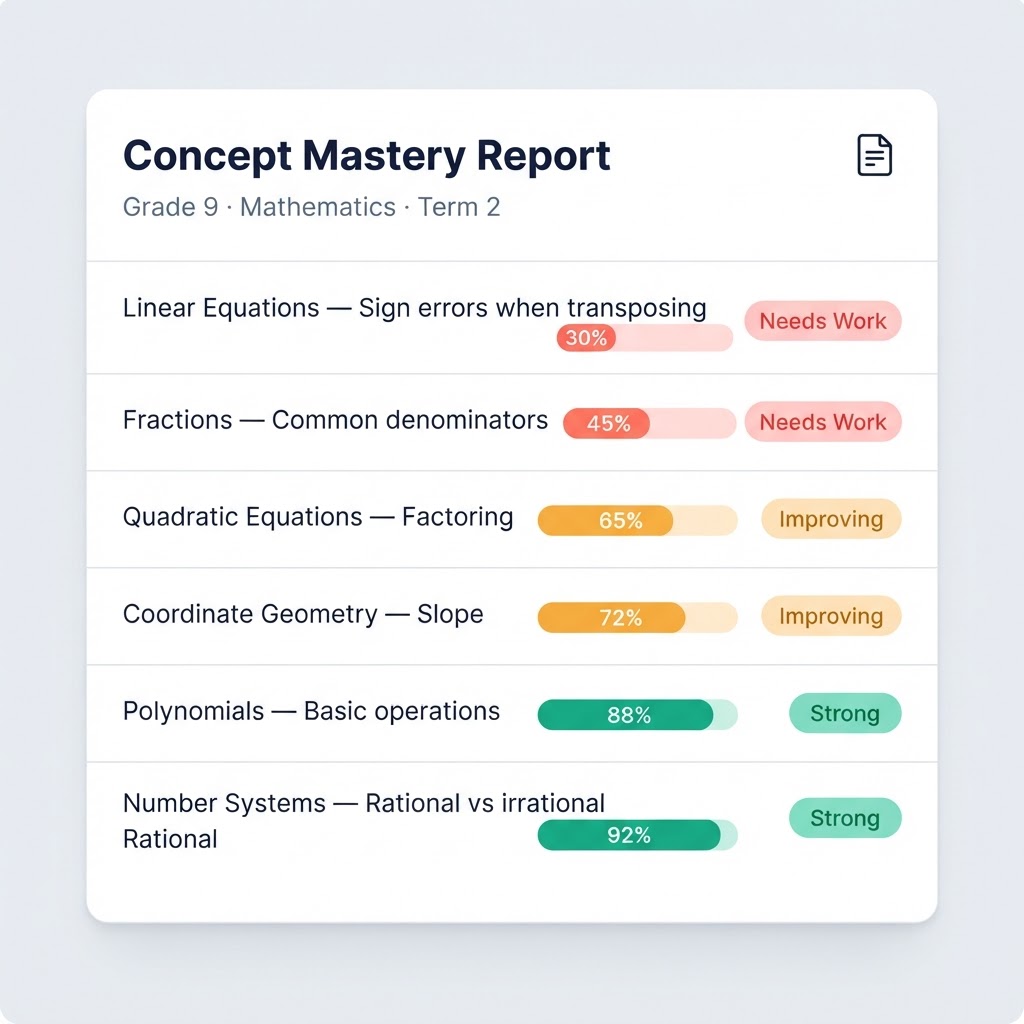
Losing marks isn't random. It's usually one or two topics quietly letting a student down. We find those, name them, and put them in front of the people who can help.
Each topic ends up in one of three buckets — Needs Work, Improving, or Strong. Straight from the papers SkoreMore evaluates.